
Threats of a company

A business threat is defined as an element of the external environment of the company that can be negative for its development and growth, it could even affect its permanence in the market.
In effect, environmental threats are presented as challenges for a company, so if defensive actions are not taken, they could affect the level of its sales and its profits.
However, if threats are detected early and the right actions are taken, they could turn into opportunities for the organization's performance in the long term.
For this reason, when a company identifies the threats that may affect it, it must pay the corresponding attention, because they are situations that have a high probability of happening and if they do occur they will cause severe damage to the company.
Undoubtedly, usually the main threats that a company faces have to do with the appearance of new competitors in the market or with the economic, political and social situations in which the company moves that may be adverse for its development.
Main threats faced by a company
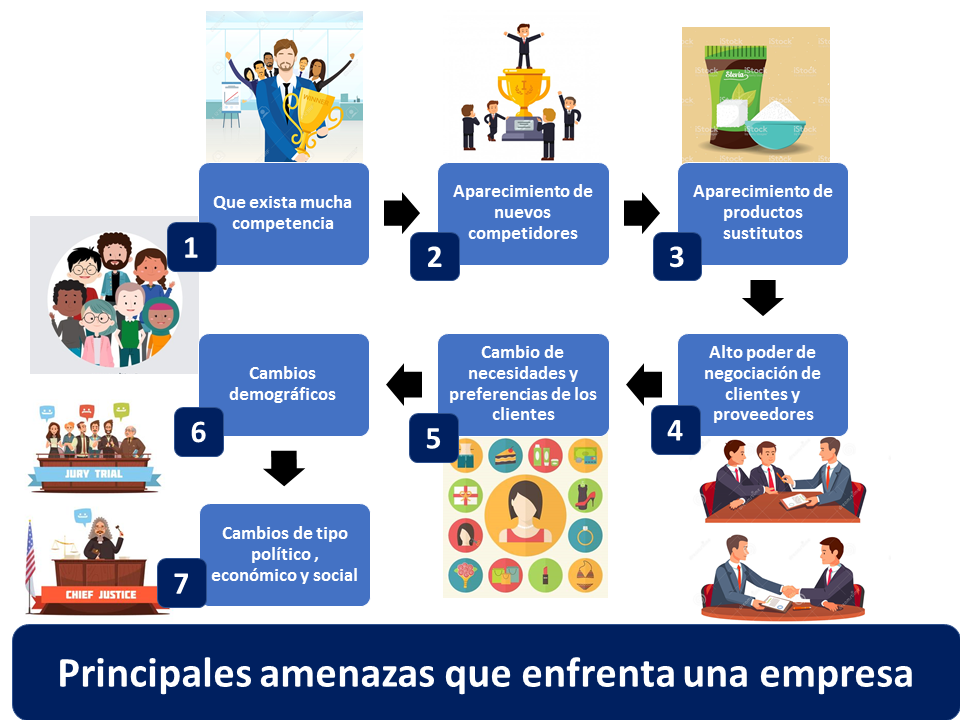
The main threats that a company can face are the following:
1. That there is a lot of competition in the segment that the company serves
Of course, if the market the company is targeting is very competitive and especially if the competitors are very aggressive and strong, it is difficult for anyone to want to leave the market. This leads to the emergence of other substitute products, price wars and the battle of advertising campaigns.
2. Appearance of new competitors
On the other hand, when the company competes in a market that has low entry and exit barriers, it frequently increases the entry of more competitors who seek to obtain a level of profit that, although not very high, can be kept stable. The company then faces profit levels that will be low.
3. Emergence of substitute products
The greater the number of substitute products that appear in a market, the less the power of the company to set its prices and maintain its profit margins; in this situation both prices and profits tend to go down.
4. High bargaining power of customers and suppliers
Now, if the company targets customers who buy from it in large volumes, or suppliers who control the supply of an important input for its production process; The company knows that it is faced with customers and suppliers who will have enormous bargaining power, so it will have to be content with moderate or low profits.
5. Change in the needs and preferences of customers and consumers
In the same way, a change in the needs and preferences of a company's buyers can cause a drop in the level of sales and consequently in the company's profits.
6. Demographic changes
In relation to demographic changes in a given market, this could cause market growth to stop or slow, as it could be the case that births are reduced, mortality increases or migration phenomena occur. Situations that could negatively affect the company, since it would lower the level of consumption and as a consequence the levels of sales, income and profit of the company.
On the other hand, changes in variables such as strict price control laws, low economic growth, a drop in the per capita income of consumers and any other change of social type as an opposition to wanting to consume the products that the company produced, will affect the income and profits that can be generated.
Finally, we will say that threats are part of the external environment of the company, so they are variables that the company cannot control. Therefore, it is very important that they can be identified at the right time so that the company prepares and takes the appropriate actions to avoid causing a lot of damage or in the most favorable case take advantage of them and turn them into real opportunities.
Leave a Reply