
reflex arc
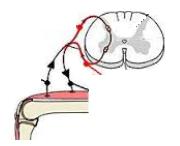
To understand what a reflex arc, we must first refer to the concept of reflex action. A reflex act is a movement that an individual performs involuntarily, as a response to a certain stimulus. The nervous structure that is in charge of controlling this movement is called a reflex arc.
Reflex acts arise from the capacity of various animals to generate a synapse in the area of the spinal cord. In this way, the body provides a response before the signal reaches the brain. According to which neurons are involved in the process, the reflex arc can present different characteristics.
When in the process only two neurons act (one sensory and one motor), the reflex arc is simple. If more than one is involved, the reflex arc becomes complex. In the latter case, intercalary neurons act between the sensory and the motor neurons.
Specifically, the reflex arc is the trajectory that follow nerve impulses throughout the body. Take the case of a blow to the knee area that causes an involuntary movement of the leg. The reflex arc goes from the sensory neuron that captures the stimulus (the blow) to the motor neuron that orders the response (the movement).
It is important to distinguish, ultimately, between the reflex arc and the reflex act. Reflex arc is the series of structures that make it possible to carry out the action which is known as a reflex act.
Reflex arc structure
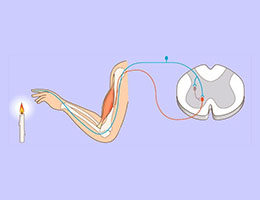
By means of the reflex arcs the organism articulates a large number of highly varied nervous processes. It is important to highlight that the reflex act is the fundamental unit of the so-called integrated nervous activity, so much so that some scholars consider it the circuit from which the other nervous structures of the body arose.
In each of the sayings circuits or paths, which are responsible for transmitting nerve impulses and constitute the reflex arc, it is possible to notice a certain number of components, some of which are mentioned in previous paragraphs:
* sensitive receptor: They are structures that specialize in transforming stimuli into nerve impulses capable of being integrated into the Central Nervous System (often referred to by the acronym CNS). Sensory receptors can be of different types, such as chemoreceptors, mechanoreceptors, photoreceptors and thermoreceptors;
* afferent or sensory neuron: its function is to capture the data and transport the message towards the spinal cord;
* efferent or motor neuron: has the task of carrying the nerve impulse from the spinal cord to the effector (defined later);
* interneuron: it is found in the integrating centers and is in charge of connecting the two neurons just described, the afferent and the efferent;
* effector: it is the organ that is responsible for generating a answer, and can be a cardiac, smooth or skeletal muscle, or a gland.
Needless to say, Central Nervous System it is of vital importance for the development of our functions. The autonomic and somatic reflex arcs coexist in it, and although they are similar in certain aspects, their morphological and functional characteristics have differences that it is essential to know.
The components that present the greatest number of similarities between both arches are the afferents. The study of efferents, on the other hand, shows us that in the somatic reflex arc there are two neurons instead of one: the first is found in the lateral horns of the medullary gray matter, or in the trunk encephalic and linked to cranial nerves; the second we can find it in autonomous ganglia of different types, such as prevertebral, paravertebral, intraorganic or preorganic. Simply put, there is a ganglion between the effector organ and the autonomic nerve center.
Leave a Reply