
Economy of scale

What is the economy of scale?
The economy of scale It is a situation with which companies manage to reduce their costs by expanding their production. Through this system, the more that is produced, the less cost per unit produced is invested.
This is a business model used for the purpose of reducing expenses and increasing production. By keeping costs below production, increase profits for a company.
Nevertheless, economy of scale has a limit, since when a certain level of cost reduction per units produced is reached, other factors begin to emerge that will increase them, such as bureaucratic factors.
Namely, a diseconomy of scale occurs, where the cost will increase due to having to manage a large production size.
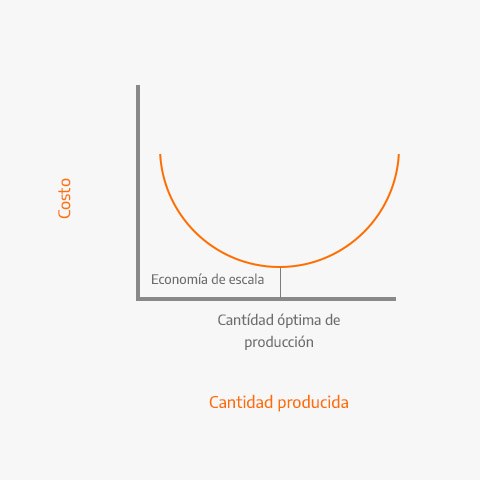
Economy of scale graph.
Advantages and disadvantages of economy of scale
Advantage
The benefits of economy of scale are as follows:
- By increasing the level of quantity produced and decreasing costs, you maximize the economic benefit.
- Prices decrease of sale to the consumer.
- By having more production, it is possible to distribute the fixed costs in more units and, therefore, reduce the cost per unit produced.
- By lowering costs, it is possible better position in the market versus competitors.
- Increase the productivity and efficiency in a company, since production is technified and the staff specializes.
Disadvantages
The economy of scale can have the following disadvantages:
- Being an expansive production and infrastructure, requires more control.
- If it expands uncontrollably, you may run the risk that economies of scale damage the image of the service or product offered.
- Requires a increase and investment in market development and research.
- If the production limits are exceeded, a diseconomy of scale (reverse effect).
Importance of economy of scale
The economy of scale is a process that companies implement, with the objective of reduce expenses of a product or service and at the same time increase your production.
In this way, it is important for both business and consumers, as the final price of the product will be more accessible if production costs have been lower.
Currently, the economy of scale allows ensure increased sales and it is of great importance to get a long-term growth.
Examples of economy of scale
Take for example a screw plant. If it produced a single screw, that unit would absorb all its raw material cost and also Expenses of machinery, plant rental and employees that were necessary for production.
In this way, the expense would make that screw illogically expensive. However, if the economy of scale and the level of production is increased, the expenses would be distributed among all the units and therefore would be less.
The more units that can be produced, the lower the cost per unit produced will be, since it will be possible to divide those fixed costs by all the units produced.
Leave a Reply