
Active

What is an asset?
In accounting, an asset is anyone good, property or right, owned by a natural or legal person, from which you can obtain benefits and which can be converted into liquidity if necessary.
Assets can provide benefits while in the person's possession or upon liquidation. This benefit may or may not be economic, but it will remain in the possession of the company for the value it provides.
Classification of assets
Assets are classified as current and non-current assets.
Current active
The current assets of a company, also known as liquid or current assets, consists of the sum of the assets that can be converted into money, that is, to become completely liquid, in a period of time less than 12 months.
Knowing current assets is important as it indicates the amount of liquidity or money that a company can have in less than a year. Inventories and bank accounts are examples of current assets.
Non-current assets
The non-current assets of a company, also known as fixed assets, is the sum of the assets that cannot be converted into money in a short-term period, generally less than a year.
The non-current assets of the company are usually necessary for its operation, such as machinery or real estate.
How to calculate the assets of a company?
Just as the assets are the assets and rights that a company owns, the terms of passive Y net worth, elements used as financial resources of an organization.
Taking into account the aforementioned, the assets of a company will be the result obtained by add liabilities and equity.
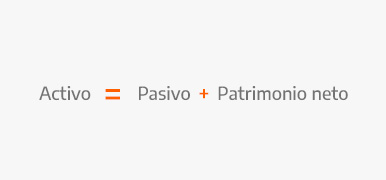
Basic accounting equation to calculate the asset.
For example, Suppose that an organization that is starting its activities has the following elements:
- Initial capital: $ 200,000.
- Loan for the purchase of machinery: $ 100,000.
- Property acquired with the initial capital: $ 50,000.
| Active | = | passive | + | Net worth |
|---|---|---|---|---|
| Initial capital $ 150,000 | Loan $ 100,000 | Initial capital $ 200,000 | ||
| Property $ 50,000 | ||||
| Machinery $ 100,000 | ||||
| Total = $ 300,000 |
In this way, the total assets of the organization is $ 300,000, like your liabilities + net worth.
Examples of assets
To better understand this concept, let's see examples of assets that apply to the world of accounting, separated between current and non-current:
| Current active | Non-current assets |
|---|---|
| Bank deposit. | Real estate (offices, home, etc). |
| Check to cash. | Machinery. |
| Available raw material. | Vehicles. |
| Cash. | Marketing patents. |
| Existence of stock. | Bonds, stocks, etc. |
Leave a Reply