
Economic cycle
Índice()
What is the business cycle?
An economic cycle comprises the stages or phases an economy goes through where a series of changes take place, following a specific order and passing through periods of prosperity, recession and depression.
This phenomenon, also known as cyclical fluctuations or business cycles, contributes to economic activities, since it allows knowing the changes that occur during their course and what measures can be taken into account to face the problems that may arise in the future.
Characteristics of the economic cycle
The main characteristics of the economic cycle are the following:
- The business cycle has a wave motionIn other words, it alternates between phases that go from expansion to depression, increasing and decreasing economic activity.
- It has a certain duration, which is determined according to the type of economic cycle that takes place at that time.
- The prices and production are affected depending on the stage of the business cycle.
- They are useful to know the causes and solutions to different problems of an economy.
Phases of the business cycle
The phases or stages of an economic cycle are the following:
- Expansion: During expansion or prosperity, the highest growth in economic activity is recorded. In this one reaches the economic boom, the highest point of the cycle.
- Recession: after expansion, economic activity decreases. This occurs in a short space of time and there the forces of production undergo a contraction. Consumption is reduced and unemployment increases, which can lead to an economic crisis or depression.
- Depression: it is one of the lowest points of an economic cycle. It occurs when the recession phase lasts for a long time. Here production and consumption are minimal.
- Recovery: economic activity begins to stabilize, increases production, wages and consumption. It leads to a stage of expansion that begins a new economic cycle.
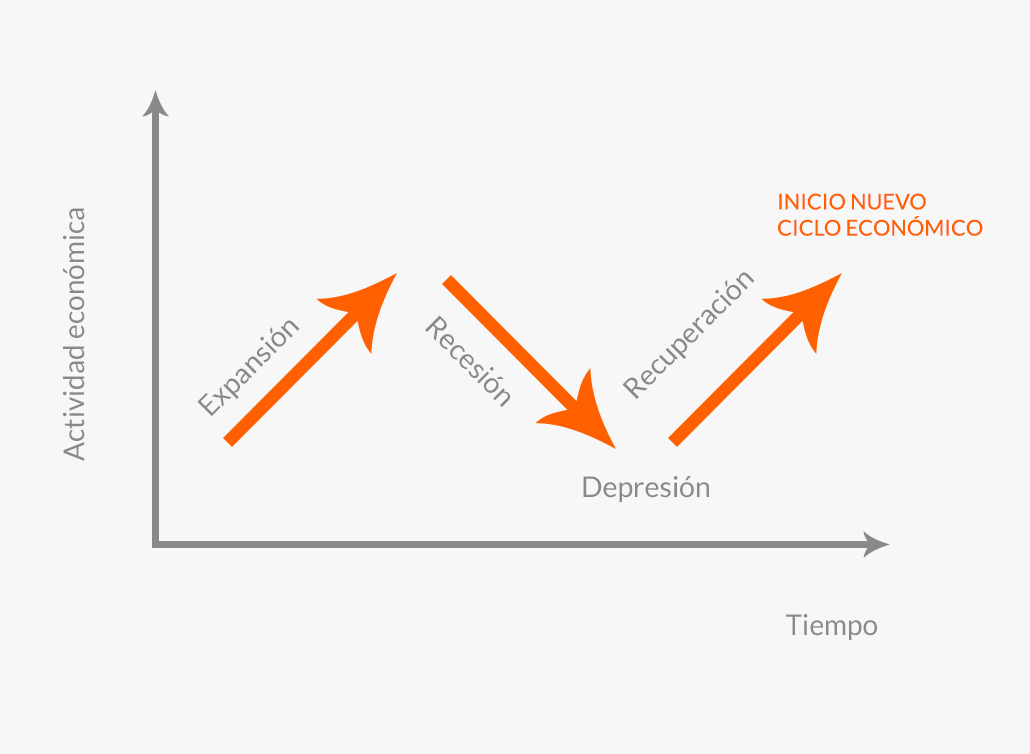
Stages of an economic cycle.
Components of the business cycle
An economic cycle is made up of the following elements:
- Periodicity: economic series that do not allow growth and decline to occur in parallel, causing the arrest of the norms of economic activity.
- Duration: time that an economic cycle lasts. This is determined according to the type of economic cycle that takes place at that time.
- Amplitude: it determines the size of the economic cycle, depending on the economic setbacks that occur.
- Recurrence: anticipates when an economic cycle will repeat.
- Shape: determines the different variations that occur in an economic cycle, demonstrating what it is composed of and the positive or negative changes that occur.
Types of business cycles
The types of business cycles are divided as follows:
- Kitchin or short cycles: those economic cycles that usually last 40 months or less.
- Juggler or large cycles: those that happen when successive crises occur and economic activity is changing. These last for 7 to 11 years.
- Cycle Kondratieff or long wave: those cycles that have a duration of 50 years approximately.
Go up
Leave a Reply