
Statistic sample

What is the statistical sample?
The statistical sample consists of the portion that is extracted of a statistical population for a given study, in order to represent, know and determine the aspects of said population.
This method is used when a census cannot be applied in certain populations, since through the sampling can establish a portion of reality to study.
Statistical sample types
Statistical sample can be classified into sample probabilistic and non-probabilistic.
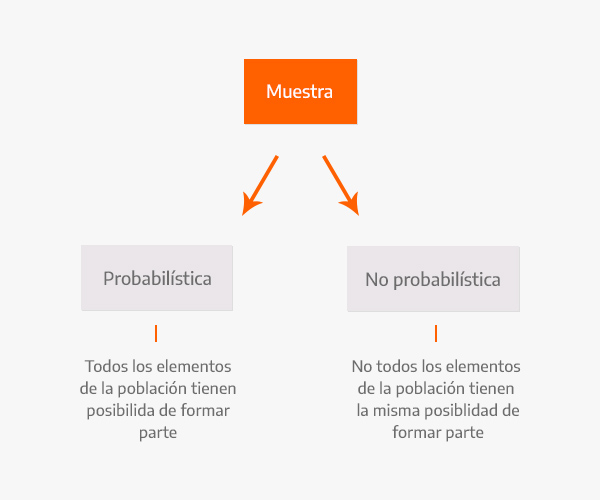
The statistical sample can be both probabilistic and non-probabilistic.
Probabilistic sample
Probability sampling is the type most used during investigations. In this, all the elements of the population or universe have the possibility of being part of the sample.
Within the probability sample we can find the following types of sampling:
- Simple random sampling: Most basic selection method, in which each subject has an identification number and, through a random lottery, some are selected for the sample. To do it you must know the number of individuals that will be needed to complete the entire sample.
- Systematic sampling: With this method, the population to work is enumerated and the researchers are in charge of listing each individual in groups of 10, randomly. Later one of the first of each group is chosen at random, thus forming the sample.
- Stratified sampling: consists in divide the population into strata or groups that share similar characteristics. Then some individuals from each group are selected proportionally.
- Cluster sampling: It occurs when the population is already divided naturally in groups, so individuals are randomly selected from each cluster to make up the sample.
Non-probability sample
In the non-probabilistic sample, the elements are selected through processes that do not offer all individuals in the population the same possibility of being chosen for the sample.
In turn, this leads to the following types of sampling:
- Quota sampling: the researchers form the sample based on certain characteristics, in order to determine achieve the same distribution of characteristics in the sample as in the population. For example, if there are 70% men and 30% women in a population, the individuals in the sample must be distributed in the same way.
- Convenience sampling: here the researcher you usually choose individuals in your sample only because of their proximity. Generally, the researcher does not recognize this sample as a representation of an entire population, but rather takes it to obtain opinions, data and information quickly.
- Snowball sampling: it is used when the researcher requires that a subject in his sample help identify another with the same characteristics and, in turn, these to others, to form the desired sample.
- Discretionary sample: Also known as judgment or criterion sampling, it occurs when the researcher selects the individuals in his sample based on certain knowledge of the population. For example, if you want to research people with psychological problems in pregnancy, you will select those women who have been through the experience of pregnancy.
Statistical sample example
Let's suppose a researcher must study the number of people who, out of a million inhabitants of a city, have a bachelor's degree. For this, it will take as a sample the situation of 1000 people randomly selected from the different areas of the city.
From these 1000 people chosen as a sample, the researcher will estimate a average and based on this you will reach a final conclusion.
Leave a Reply