
What is Military Psychology?
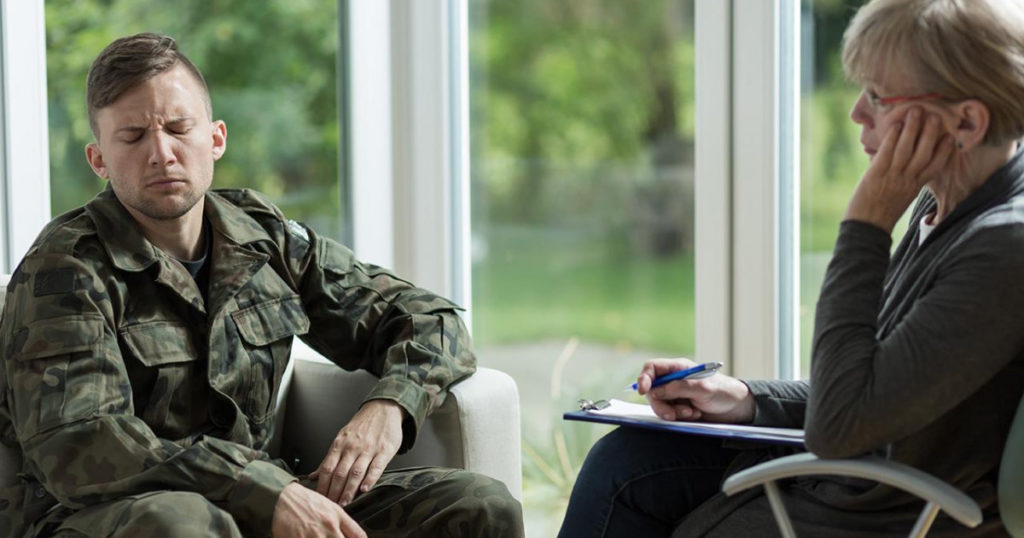
Military Psychology has the function of evaluating, evaluating and treating the members of the Armed Forces, intervening both in the selection process and during the period of military service.
Combatants and people who are engaged in the military are a population at risk of presenting psychological alterations since they are exposed to multiple sterant situations. In this way, it will be important to work to prevent the appearance of possible disorders or treat them when they are already present in order to ensure that the affected person can be incorporated as soon as possible.
There are many areas or specialties in which the military psychologist can act, such as teaching, clinical, community social, organizations or health, doing promotion and prevention work. In this article we will define Military Psychology, We will also explain who are military psychologists and what are their main functions.
How is Military Psychology defined?
Military Psychology is a branch of Psychology that deals with evaluating and evaluating the behavior of members of the Armed Forces, both in their selection and during the performance process, to assess which function is best for each one as well as to control and treat possible psychological problems that may appear. They will also take into account the behaviors and capabilities of opposing military forces.
As antecedents of the application of Psychology in the military context, highlight Robert Woodworth who created the Woodworth Personal Data Sheet (PDS) the first personality test that aimed to detect soldiers who presented vulnerability and susceptibility to develop a neurotic condition and thus to be able to carry out an optimal selection process in order to prevent future damages and alterations.
Even if at first the intention was to use it during the First World War, did not arrive in time for this task, but this personality test was used in multiple psychological investigations and served as a model and antecedent for many other tests that sought to measure similar aspects.


The military psychologist
To access to work as a military psychologist, a series of requirements must be met, first, and as in any case that is practiced as a psychologist, you must have a degree in Psychology. In the same way, different aspects are also controlled, such as not being deprived of civil rights or not having committed a criminal offense.
If you meet and meet the relevant conditions, you will be able to access the selection process that consists of a competition procedure and an opposition procedure.. The contest phase consists of evaluating the merits of the different applicants in order to make an ordered list of preference for each one according to their preparation.
In the same way, in the opposition phase, different tests or examinations will be carried out that will consist of a test of psychophysical aptitudes, in this physical, psychological and medical capacities and aptitudes will be evaluated, in this way a result of suitable or not suitable will be obtained; an English language test, where written comprehension, grammar and vocabulary will be assessed; and a knowledge test, consisting of assessing the knowledge of each psychological specialization.
Thus, the military psychologist can specialize and intervene in: Organizational Psychology and Human Resources; Military Operational Psychology, which consists of assessing, taking into account, human and group factors and leadership ability in military operations; Preventive and expert psychology; Clinical psychology; Educational psychology, for professional orientation; and Social Psychology, in order to assess individual and group behavior. In this way, now that we already know the different specialties that the psychologist can perform in the military field, it will be easier to classify the different functions that he exercises.


Main functions of Military Psychology
Working and dedicating yourself to the military is not easy and requires constant control, both prior to selection and during service to the Armed Forces, to anticipate and manage possible deregulations or alterations given that the conditions are especially stressful.
Likewise, one of the main functions of the military psychologist will be to assess and control the state and balance of mental health of the members of the Armed Forces and their environment, such as their family. In this way, it will intervene in the selection of personnel, taking into account those who have the most appropriate characteristics according to the position that is required to be filled and the responsibility involved in dedicating themselves to the military field.
Therefore, psychologists will be in charge of passing the relevant tests and interpreting the results to assess the psychophysical aptitudes of the applicants, examining both their state of mental and physical health, their different capacities such as memory or reasoning and their characteristics of personality and possible psychological alterations that may be a reason for exclusion.
The work of the psychologist in the field of military education is also extensive and important, with a quarter of military psychologists performing this function. It will carry out its functions both with the students to guide them in their study plans and objectives as well as with the teachers, supporting and collaborating to achieve an optimal educational model that promotes and works on the skills and abilities suitable for the pertinent professional objectives.
Another process where the work of the psychologist in the military field will be fundamental will be to help the members to adapt optimally to their new life, military life, since this involves a great change and many more demands and rules.
In the same way, as we have already pointed out, military dedication can be complicated, making personnel have to face extreme and very stressful situations that can lead them to present borderline thoughts or behaviors such as suicide, the military population is especially vulnerable to committing this type of act, since they have facility to obtain the necessary means to commit them.


For this reason it will be essential to do a good job of prevention, selecting as we said the right people and controlling their evolution, it will also intervene in possible stressful or crisis situations to be able to treat and stabilize as soon as possible, always keeping in mind the situation of those close to them. and relatives.
Therefore, it will be vital to have a professional, the psychologist, who deals with the mental state since post-traumatic stress situations that appear during or after wars are typical, both in soldiers who are in combat and those who have not fought, since it is not necessary to be directly exposed to the traumatic situation since the fact of being aware and receiving information about it can also create a post-traumatic stress disorder (PTSD).
Another typical maladaptive behavior that they can present is self-injurious, consisting of causing harm to oneself and that can end up leading to suicidal thoughts and attempts, as we have already discussed. It will be vital to teach and work so that they learn to channel their emotions correctly and thus be able to avoid or treat risk behaviors and situations, with the objective that the military can rejoin their functions as soon as possible and be able to perform them in the best possible way.
Similarly, linked to the fact that the combatants belong to the population at risk, it will also be essential to prevent possible substance use and addiction, providing information and imparting knowledge of the effects and consequences of toxic consumption, creating and working in groups. to get them to support each other, creating healthy leisure environments, training strategies to know how to decline and resist the supply of drugs and establish standards of conduct in order to reduce the possibility of access to substances within the military context.
As we have already advanced, the focus of action of psychologists in the military context will not focus only on the combatants but will also include a wide group of individuals. They will also work with their environment, with their families and the society where they belong, since they will be affected in the same way and may present different types of alterations.


Likewise, professional psychologists will also participate in the design and construction of operations designs to confront and combat the enemy or promote and continue to strengthen motivation and combative attitude. The destabilization and loss of physical and psychological strength is very common given the extreme conditions that are experienced, for this reason the support and work of the psychologist will be very important to achieve a prosperous state and functioning of the army.
It should also be mentioned that the Armed Forces founded in the 80s the Social Institute of the Armed Forces, which is an occupational center that cares for individuals with some type of intellectual disability. The main objective of this institute is to work on the different skills of users so that they can more easily access the workplace and achieve better social integration, to achieve this purpose occupational workshops are given, social support and psychological care are provided and preparation for job placement.
Therefore, the role of the military psychologist is essential and needs specific training and preparation, since they will deal with cases of people who risk their lives and therefore it is very easy for mental health alterations to appear, thus needing constant support to improve their condition and performance.
Leave a Reply