
Non-probability sampling

What is non-probability sampling?
Non-probability sampling is a technique used in the statistical sample, that unlike the probabilistic sample, it does not allow all individuals in a population to be investigated, have the same selection opportunities.
In this type of sampling, those individuals who, by fulfilling a certain quality or characteristic, benefit the research.
Non-probability sampling types
Non-probability sampling can be classified into mQuota, Convenience, Snowball, or Discretionary Sampling.
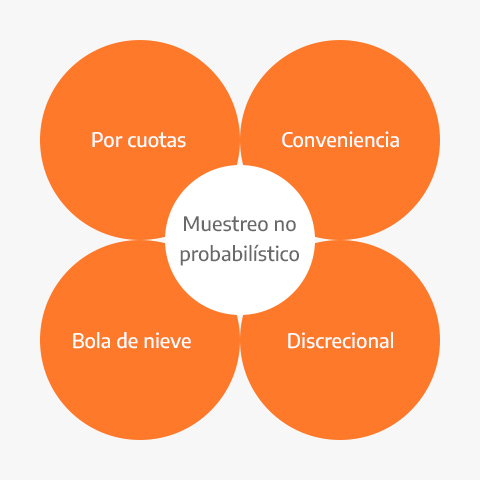
Non-probability sampling types.
Convenience sampling
Non-probability sampling for convenience is one where the researcher performs the sample, selecting individuals you consider accessible and quick to research. This, generally, he does by proximity to himself.
For example: a researcher decides to carry out a study on the opinion of a teacher in a given classroom. Using convenience sampling, you make up your sample with the first 5 students on the classroom list.
Quota sampling
Through quota sampling, the researcher ensures that the sample is fair and proportional, according to the characteristics, qualities or traits of the population to be studied.
For example: a researcher must carry out a sample on the employees of a company, in which 60% are women and 40% are men. To do so, select individuals who are proportional to the population, through convenience sampling or the researcher's choice.
Snowball sampling
Also known as chain sampling, this method consists of the researcher requires, from the first subject in the sample, to identify or designate another person who meets the research requirements.
For example: a researcher decides to carry out an investigation whose sample is made up of individuals with a rare disease. In this way, when finding an individual with these characteristics, the researcher asks for help to find other people with these conditions to make up the sample.
Discretionary sampling
Also know as judgment or intentional sampling, through this technique the subjects are chosen to cform a specific group, of people who are more suitable for analysis than others.
For example: You want to conduct research on the behavior of parents with their children. Therefore, the researcher selects as a sample people who have children, since he considers them suitable for knowledge to be part of the research.
Advantages and disadvantages of non-probability sampling
Advantage
The main advantages of non-probability sampling are as follows:
- Lower costs to conduct the investigation.
- They can control the characteristics of the sample.
- Carries less time, since the individual who will be part of the sample is known.
- They can be known unusual features.
Disadvantages
The main disadvantages of non-probability sampling are as follows:
- It does not ensure full representation of the population.
- It does not generalize and it is subjective.
- It is not recommended in the case that the investigation is causal or descriptive.
Examples of non-probability sampling
Next we propose Some examples To understand the non-probability sample more clearly:
- A teacher wishes analyze the number of students with realistic goals, so he uses known volunteers and sends the survey back to the school, for those students to act as a sample.
- A social researcher chooses 50 unemployed people in a population and asks 5 of these to find another 10 unemployed people, to finish the analysis and research using the snowball method.
Leave a Reply