
halberd
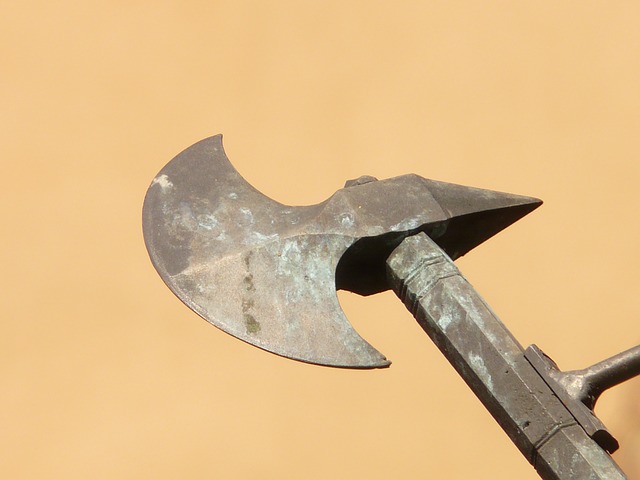
Halberd it is a term with an extensive etymological journey. Its most distant origins are found in the Germanic word helmbart, which led to Middle High German helmbarte: this concept, in turn, is formed with helm (translatable as "handle") Y barte (which translates as "axe").
Halberd Characteristics
Helmbarte derived in French hallebarde and in italian halberd. So we get to our language, where the idea refers to a weapon formed by a extensive handle with a tip and one cross blade It has a crescent appearance on one side and a sharp ending on the other.
Here you can see its characteristic shapes, such as its semicircular blade
The shaft of the halberd can measure up to two meters. At the end, the tip type appears spear and the knife with an ax blade in one sector and a kind of hook in the other. Models from the 16th and 17th centuries, when the title of halberdier to name the sergeants who used it, it had a shorter shaft.
As a curious fact, in Christianity we also find this polearm in the iconography referring to the Apostle Judas Thaddeus, as a attribute yours. This means that by means of the halberd it is possible to identify this saint. The attributes were widely used to facilitate the transmission of religious messages to people who could not read.
His origins
It is estimated that halberds were born in Chinese territory, since there is evidence of polearms of considerable antiquity whose functions were very similar. On the European continent it began to develop in the Middle Ages, around the fourteenth century, through Scandinavia and Germany, when it adopted its most characteristic features.
However, it became especially popular thanks to its use by swiss mercenaries, soldiers who were characterized by serving in the armies of other nations, particularly those that belonged to the French crown.
Coming to the end of Middle Ages, halberds were used frequently in the infantry, maintaining that significance until the XVII century. The halberd infantry even prevailed over the chivalry heavy in different historical clashes.
The popularity of the halberd was so great that numerous troops from elite belonging to the nobility wore it in highly ornate versions, something that remains to this day. We can mention other polearms that coexisted with the halberd and that could be considered within the same family, such as the partsana, the archa and the glaive. In feudal Japan, on the other hand, they created the naginata, whose blade was thinner and more aerodynamic.
Currently
Today halberds are usually worn in parades and in various public events. In those cases, they are displayed as ceremonial weapons, although there are also formations that use them as combat weapons, to the point of using them in your workouts. This happens with the so-called halberdiers of the Pontifical Swiss Guard and of the Spanish Royal Guard.
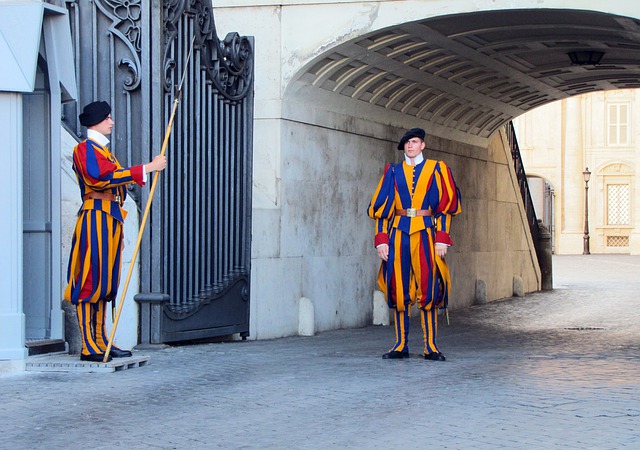
The halberd is present in the Pontifical Swiss Guard
The Pontifical Swiss Guard It is a military body that is responsible for providing protection to the dad, its chief of ceremonies, and to the Holy See. Today it has a number of soldiers around one hundred, which makes it the world's smallest professional army. It emerged in the 16th century, more precisely in the year 1506, with 150 soldiers.
With respect to Company of Royal Halberdiers Guards, is in charge of protecting castles (the alcazares) and accompany the Kings every time they go on excursions or participate in public events. This has been very common in monarchies of Europe. Before Switzerland, for example, Denmark did, and little by little other European countries joined.
Leave a Reply