
delivery

The act and result of lighting it is called delivery. The verb lighting, on the other hand, can be used with reference to the fact of bring clarity or luminosity or to act of giving birth.
It is called delivery, therefore, at the end of the Birth: the culmination of human pregnancy that occurs when the baby leaves the uterus of the mother. With childbirth, the age of the person begins to be counted (that is, a human being reaches its first year of life when one year has elapsed from the moment of its delivery).
Although the exact point at which life is considered to begin is a matter of philosophical and religious debate, it can be said that childbirth marks the birth of the individual. From that moment on, the baby will no longer be inside the mother's womb, but will have an autonomous existence, even when it requires numerous cares to survive and develop.
The delivery begins to take place with the irruption of contractions in the mother's womb, which, as the time of the baby's delivery approaches, they become more frequent and intense. To this process are added changes in the cervix, which are dilates. The baby, in this way, begins to descend through the uterus until it comes out, if it is a natural birth, through the vagina. Delivery also involves the removal of the placenta and of various membranes.
If we take a little distance, we can say that delivery is the third phase of labor, a process that occurs after an average of forty weeks' gestation. Before entering the first phase, the so-called prepartum, during which oxytocin (a hormone that occurs naturally in the pituitary gland to stimulate labor) travels through the blood and it is then that the first contractions appear, although they are not always perceived by the mother.
In labor, the mucous plug is removed, although the time when it disappears is not the same in all cases: the distance between this event and delivery can be days or minutes. The first of the three stages mentioned above is the dilatation, which is divided into two:
* passive: to reach three centimeters it must take between six and eight hours, although in some women this takes a full day. Contractions are accentuated and pain worsens;
* active: the frequency of contractions increases considerably, appearing every two minutes. Usually the rate of dilation is one centimeter per hour. The cervix also widens, so that the baby can lower.
The name of the second phase is expulsive, which begins when the dilation reaches ten centimeters and the baby's skull reaches the end of the birth canal. Contractions spread but last and hurt more than before. The mother should push rhythmically, with the collection of oxygenate your child between each pressure. At the end of this phase, the baby comes out and receives normal care, such as cutting the umbilical cord.
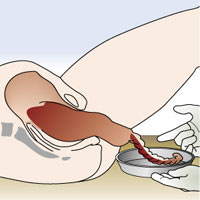
Finally comes the delivery, which is counted from when the baby has come out until the mother expels the placenta. For this to occur, minor contractions occur. intensity than the previous ones, so that the uterus is reduced and all the elements that are no longer useful are detached.
The idea delivery may also refer to a symbolic birth. For example: "The birth of this project occurred a month ago, when I met Matías in a bar".
Leave a Reply