
ensign

The classical Arabic word fāris, which can be translated as "Knight", derived in Hispanic Arabic alfáris. This term later came to our language What ensign: the officer who, in certain armed forces, has the lower graduation.
The concept emerged in the Iberian Peninsula, where it was used with reference to the representative or second head of a king. Over the years, however, the junior officer was called ensign. The students of a academyThus, they are second lieutenants before becoming lieutenants.
Whoever was in charge of carrying the flag in a troop received the name of Major Ensign. Similar task had the ensign to the king, a magistrate who carried the banner of the monarchy in those battles in which the own King.
Currently the notion can refer to different ranges according to the country. On Argentina, for example, Ensign is the initial degree in the officers of the Air Force. When a student graduates from the military academy, he becomes an ensign and later promoted to lieutenant. Also in the Gendarmerie there is the rank of ensign, preceded by sub-ensign and followed by first ensign.
On Colombia, the Policeman, the army, the Air Force and the Navy They have the rank of lieutenant. In all cases, it is linked to the last year of training and applies to those who are about to graduate from the school cadets.
If we focus on the maritime terrain, we can find the frigate ensign (the lower ranking officer) and to ensign of the ship (the rank that follows frigate ensign), to cite two cases.
Royal Ensign of the Incas
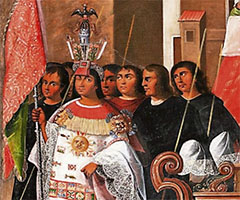
Centuries ago there was a institution of an Indian type that allowed to name a Royal Ensign of Naturals, Royal Ensign of Noble Indians or, as can be seen from the title, Royal Ensign of the Incas. Its creation took place throughout the Viceroyalty, specifically in the Peruvian city of Cuzco (also written with s instead of z, Cusco), in the middle of the 16th century and through the Royal Decree.
Carlos I of Spain supported the birth of this class of leadership specifically to recognize the support of Christopher Paullo Inca during the conquest del Collao (also known as Titicaca plateau, Andean highlands, Collao plateau or south american highlands) and the victory against Manco Inca Yupanqui, the first Vilcabamba rebel of the four who demonstrated.
Cristóbal Paullo Inca was, therefore, the first Royal Ensign of the Incas, but later other people enjoyed the same honor, and among them were Ynga Pascac, Cayo Topa, Guallpa Roca and Don Felipe Cari Topa.
While the viceroy Toledo remained in Cuzco, the Inca nobility had to undergo a change of organization to become made up of twelve houses (lineages or panacas), which corresponded to each of the Incas who had ruled before the Spanish invasion. As of the year 1595, it was decided that these houses would be represented by two electors, who, together, would make up the Cabildo de los Indios Nobles.
The twenty-four electors who were part of the Cabildo had to appoint a Royal Alferez by means of suffrage. He himself had to leave during the procession that took place in the feast of the Spanish patron Santiago Apóstol, wearing typical Inca clothing and carrying the royal standard. Under the llauto, the outfit that the Inca rulers used to wear, you could appreciate the mascapaicha, a tassel of red wool, gold threads and feathers that was used in events such as parades.
The Royal Ensign of the Incas was accompanied by the correspondent from Spain. In the series of fifteen paintings called Corpus Christi, whose authorship is uncertain, it is possible to appreciate several of the lieutenants of this epoch.
Leave a Reply