
criminal action

The criminal action It is one that originates from a crime and involves the imposition of a punishment on the person responsible in accordance with the provisions of the law. In this way, criminal action is the starting point of the judicial process.
The origins of criminal action go back to the times when the Condition he became a creditor of the monopoly of the use of force; When the criminal action was inaugurated, it replaced personal revenge and self-defense, as the State assumes the defense and compensation of its citizens.
The criminal action, therefore, supposes a exercise of power by the State and a right to guardianship for citizens who suffer the consequences of a crime committed against their person.
In a philosophical sense, criminal action is one of the ways that the State has to reestablish social peace that it was altered by the commission of a crime. The promotion of a criminal action can be exercised both by the state power and by individuals.
Once a criminal action has been initiated, its first stage consists of the investigation (the search for evidence), the prosecution (the exercise of the action before the competent court) and the prosecution (a punishment is required). During the judgment, each of these steps is specified and, based on the action, the judge is in charge of issuing the resolution in accordance with the provisions of current laws.
Types and forms of criminal action
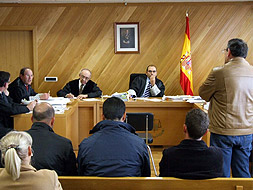
There are two types of criminal action, public and private. The first refers to what concerns the public prosecutor, without prejudice to the participation of the victim and the second corresponds to the victim specifically.
There is also a type of action that is classified as criminal public action at private request that exists when the exercise of public action depends strictly on a private instance, in such a situation the public prosecutor must present an instance to be able to represent said action.
The facts that can be prosecuted by private action are violations of property, injury or swearing that affects an individual or violation of industrial property.
For its part, the private body can pursue de facto means, blows and wounds that leave injuries, threats, robberies without weapons and without violence, fraud and falsification of deeds or documents, among others. In this case, the action is born when the victim files a complaint and, from that moment on, the prosecution of the accused begins.
When the punishable act has been carried out against an incapacitated person or a minor by one of their parents or guardians, who would theoretically be their representatives, for obvious reasons it is the public prosecutor that exercises the action.
There are cases where the criminal action can be extinguished, such as when the accused or the victim dies (as long as their heirs do not continue with the action), amnesty is offered, the accusation is abandoned, the term of the conditional suspension of the criminal procedure or prescription or withdrawal of the instance expires private (if the public action depends on it).
It is also important to note that the civil action can be exercised simultaneously with the criminal one, as long as the rules set forth in the criminal procedure code. Sometimes they are dealt with jointly and sometimes separately in civil courts; on this last case exercise is paralyzed until a verdict is rendered.
Leave a Reply