
angular acceleration
To know what angular acceleration means, it is necessary that, first, we proceed to know its etymological origin. In this sense, we have to emphasize that this is what the two words that make it up have:
-Acceleration derives from the Latin, specifically, from “acceleratio” which can be translated as “the action of proceeding to increase speed”. It is the result of the sum of three differentiated parts: the prefix “ad-”, which means “towards”; the adjective "celer", which is synonymous with "fast"; and the suffix “-ción”, which can be translated as “action and effect”.
-Angular, on the other hand, is a word that comes from the Greek, exactly from "ankulus", which means "bent" or "having the shape of an angle".
The acceleration is he act and result of accelerating (increase speed, grant speed). The concept can also be used to name the magnitude that indicates the increase in speed in a unit of time.
Angular, for its part, is the adjective that qualifies what is linked to a angle: the figure of the geometry which is made up of two lines that share the same starting point.
After reviewing these definitions, we can get into the notion of angular acceleration. It's about the disturbance that is registered in the angular velocity in a certain period of weather.
We must therefore go on to analyze the idea of angular velocity to find out what angular acceleration is. Is velocity measures, per unit of time, the angle turned by an element that performs a rotational movement.
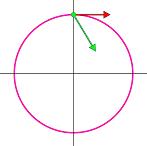
This means that the angular acceleration is linked to how the velocity reached by a rotating element changes in a motion of rotation. This acceleration is expressed through radians per second squared and is mentioned as the letter alpha of the Greek alphabet.
It should be noted that both the angular acceleration and the angular velocity have a vector character. Acceleration does not change the axis of rotation, which maintains a stable direction in the space.
Within the field of Physics, what is the angular acceleration plays an important role. So much so that it is used to establish that there are several methods to calculate it, among which the following stand out:
-Calculate the average angular acceleration. In order to perform this operation, steps such as measuring the initial angular velocity, the final angular velocity and the elapsed time are required.
-Calculate the instantaneous angular acceleration. To be able to undertake this other operation, it is necessary to previously determine what the position of the angular function is, look for the function of the angular velocity, find the function of the aforementioned acceleration and apply the data to find the instantaneous acceleration.
-Review the angular acceleration that, among other things, goes through measuring the angular movement in radians.
If we take the case of a Body that performs a uniform circular motion (known as MCU), we will notice that the angular acceleration is equal to 0. This is because the angular velocity is constant: thus, if the angular velocity does not change, there is no angular acceleration.
When the circular motion is uniformly accelerated (MCUA), on the other hand, an angular acceleration is recorded that remains constant.
Leave a Reply