
Intervals
What are the intervals?
An interval is a set of real numbers that is between two extremes, a and b. It can also be called a subset of the real line.
For example, the numbers that satisfy a condition 1 ≤ x ≤ 5 or [1;5] they involve a range from 1 to 5, including both.
If the application of the interval is taken into account to observe the behavior of a variable, a time series is taken and an interval is chosen.
Classification of intervals
There are 4 types of mathematical intervals, these are: open, closed, semi-open and infinite.
Open interval
An open interval is one that does not include the extremes between which it is included, but all the values located between them. It is represented by an expression of the type a
For exampleIf we have the open interval (1; 5), we will have the set of numbers greater than 1 and less than 5. Not including 1 and 5.
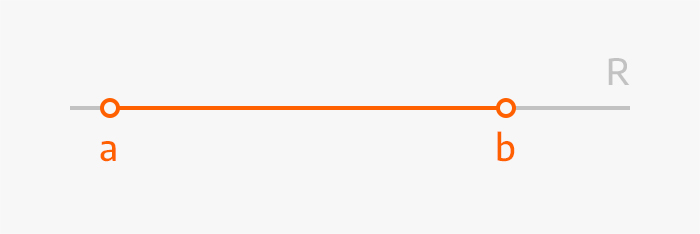
Representation on the real line of the open interval (a; b).
Closed interval
A closed interval is one that It includes the extremes of the interval and all the values between them. It is represented by an expression of the type a ≤ x ≤ b or [a;b].
For example, if we have the closed interval [1;5], we will have the set of numbers greater than or equal to 1 and less than or equal to 5. Including 1 and 5.
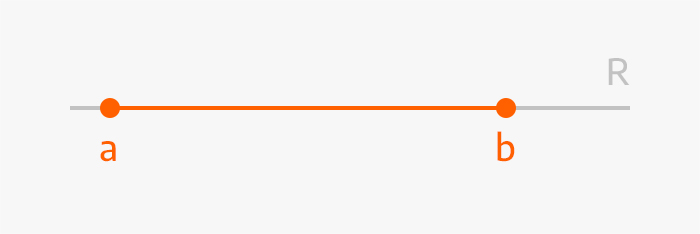
Representation on the real line of the closed interval [a;b].
Semi-open interval
A semi-open interval is one that includes only one of the extremes of the values that lie between them, so that the other extreme is excluded. Both the extreme right and the left can be included or excluded.
It is represented by an expression of the type a ≤ x or a
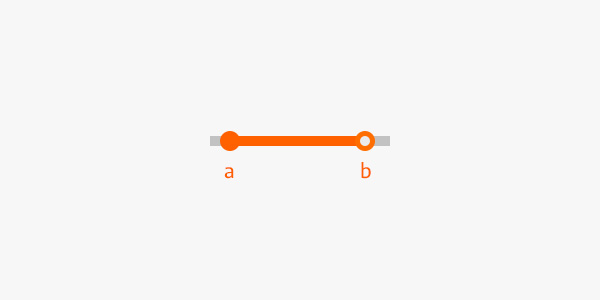
For example, if we have the interval semi-open [1;5), tendremos un conjunto de números mayores o iguales a 1 y menores a 5. Incluyendo el 1 pero no el 5.

Representación en la recta real del intervalo semiabierto [a;b).
Intervalo infinito
Un intervalo infinito es aquel que tiene un valor infinito en uno o ambos extremos. El extremo que posea el infinito será un extremo abierto. En caso de que ambos extremos sean infinitos, será la recta real.
Se representa con una expresión del tipo a ≤ x ó x ≤ a, lo que sería [a;∞) ó (-∞;a). Estos además pueden contener intervalos cerrados, como [a; ∞).
Por ejemplo, si tenemos el intervalo infinito [1;∞), tendremos un conjunto de números mayores o iguales a 1 en adelante.

Representación en la recta real del intervalo infinito [a;∞).
Ejemplos de intervalos
Para entender mejor el concepto de intervalos, veamos los siguientes ejemplos, junto con su clasificación y números comprendidos:
| Intervalo | Tipo | Comprende |
|---|---|---|
| (-4;6) | Abierto | Mayores que -4 y menores que 6. |
| (16;4) | Abierto | Mayores que 16 y menores que 4. |
| [5;6] | Closed | Greater than or equal to 5 and less than or equal to 6. |
| [10;14)[10;14) | Semi open | Greater than or equal to 10 and less than 14. |
| (1; ∞) | Infinite | Greater than 1 onwards. |
Leave a Reply