
ADSL
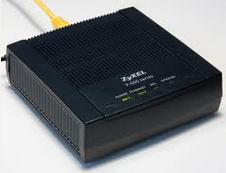
ADSL is an acronym that comes from the English language and refers to the expression Asymmetric Digital Subscriber Line. In our idiom, said phrase can be translated as Asymmetric Digital Subscriber Line.
ADSL is a class of technology that allows the Internet connection Through the use of the traditional telephone line, transmitting the digital information in analogue mode through the symmetrical copper pair cable. In other words: the user connects to the Network using their telephone line, but with broadband (unlike the old internet connections of type dial-up, which used a modem to transmit the data).
In the case of the ADSL connection, a router it is responsible for modulating the signals with the data in a frequency band that is higher than the band used in telephone communications. A filter, on the other hand, it allows the signals not to suffer distortions, separating the already modulated signals from the telephone signal.
The ADSL connectivity, in this way, works with three channels of communication on the same wire. One channel allows data to be downloaded, another is used to send the data and a third channel enables the development of conventional telephone communications.
The ADSL line is "Asymmetric" since the download capacity is higher than the upload capacity of the data. This is due to a use of resources that is linked to the usual behavior of users of the Internet, which tend to download more data than they send to the net.
The borders of ADSL
Although until the end of the 90s many users had the already archaic telephone connection to the Internet, which offered a maximum download speed of 56 kbps, and only a few began to savor other technologies, such as fiber optics, the standard nowadays it is ADSL, since it is offered to prices very accessible and achieves more than enough performance for the average customer.
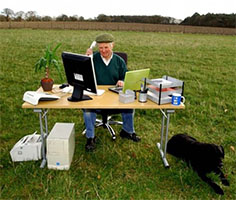
But what happens in rural areas? The answer, at the end of 2016, is truly alarming, especially for those who have never lived in the countryside: in many cases, such as those scattered, there is only one satellite internet service, whose characteristics are very poor and its price, exorbitant. It is not normal for ADSL to reach the outskirts of cities, since an expensive infrastructure is necessary that apparently is not justified before the small number of clients who live far from the asphalt.
The experience of connecting to the Internet through a service satellite is very different from what we can have with ADSL. Above all, the ping it is considerably slower; This means that the computer takes too long to communicate with a certain server, such as that of its own Internet provider, and start exchanging data packets, which makes it impossible to carry out activities as normal as playing online, since the lag is unsustainable.
Another negative aspect of this and other alternatives to ADSL, such as 3G Y 4G, is he data limitAlthough we are used to controlling our use on the mobile, the Internet at home is different, since we can use it to buy programs, movies and music, and its weight can be considerable. Live away from areas with coverage ADSL, therefore, brings too many complications for those who need to make intensive use of the Internet, either due to the monthly traffic limit or the slow ping rate.
Leave a Reply