
arthropods
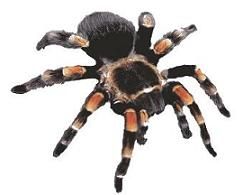
The arthropods are the animals invertebrates that form the most diverse edge of the animal kingdom. These animals have their bodies covered by a exoskeleton known as cuticle and formed a linear series of ostensible segments, with appendages of articulated pieces. The arachnids, the insects and the crustaceans they are arthropods.
Specialists estimate that there are more than a million species arthropods, which represents about 80% of all known animal species. Most arthropods are insects, and many of them are adapted for life in the air.
Despite the great variety of arthropods, several common characteristics can be mentioned, such as the presence of a chitinous exoskeleton and of articulated appendages, or the body formed by repetitive segments (a phenomenon that receives the name of metameria).
In addition to all these characteristics, it is also important to establish that another of the main hallmarks of arthropods is their reproduction system. In this case we can underline that the female is the one in charge of laying eggs, once fertilization by the male has taken place.
In this case, the result of this process can be of two types. Thus, an individual similar to its parents can be born directly from this egg, or a larva can be born from that egg that, little by little, will be transformed in a process known as metamorphosis until giving rise to the aforementioned being.
The exoskeleton is made up of different layers. The surface layer, which is called epicuticle, it is very thin, it is composed of proteins and lipids, and it has a waterproofing function. The procuticle It is the thickest layer of the cuticle and can be divided into exocuticle (the stiffest part) and endocuticle (flexible).
It should be noted that, throughout its growth, the arthropod sheds its exoskeleton through a process of ecdysis.
There are various classifications that exist to determine the different types of arthropods that exist today. However, the most common is to make groups of these living beings based on the number of legs they have. In this way, we would find four great sets:
Arthropods with six legs. Within this group would be the insects.
Arthropods with eight legs. Those known as chelicerates are what give it its shape. As an example of these we would have spiders, scorpions or even those known as horseshoe crabs. The main characteristic that defines them and differentiates them from the rest of arthropods is that they do not have antennae.
Arthropods with ten legs. Crustaceans are those included in this set, that is, crabs, shrimp or lobsters.
Arthropods with more than twelve legs. In their case, the members of this group are the myriapods, that is, living beings such as centipedes.
Finally, we can highlight the particularity of the eyes of arthropods. These eyes can be simple, with a simple retina and a transparent cornea that covers them, or compounds, formed by various elements (the ommatidia) that are located radially and can point to different directions.
Leave a Reply