
Auk
The Alca means the Free Trade Area of the Americas, started in the year 1994 with the participation of thirty-four countries.
The Alca project was born with the idea of expanding the benefits of NAFTA or North American Free Trade Agreement, to the rest of the American countries.
- The first meeting was held in the city of Miami, United States in December of the year 1,994, this meeting was attended by representatives of 34 countries in the region
- After said meeting, an agreement was reached to create the Free Trade Area of the Americas. The purpose was to achieve the gradual elimination of obstacles to trade and investment in the countries of America.
- Furthermore, it was expected that the entire negotiation process would not extend beyond 2005.
- Therefore, the expectation was that by the year 2000 much progress would have been made.
- However, the only country that did not participate was Cuba.
Impact of Alca
In its origins, Alca had very ambitious goals, since its main purpose was to open the economies of the American countries to international competition, taking the market system as the basis for the efficient economic allocation of resources.
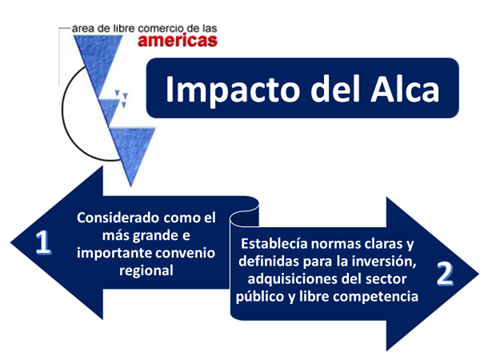
- That is why the Alca is perceived as the largest and most important regional integration agreement that has arisen in the modern world, seeking to consolidate commercial freedom among the countries that are part of the agreement.
- In addition, clear and well-defined rules are established for investment processes, public sector acquisitions, everything related to policies for free competition and the incorporation of topics, such as: access to markets, services and investment, countervailing duties, procedure antidumping, subsidies, competition policies and all matters relating to intellectual property rights.
Negotiation process
In order to consolidate agreements, the following summits were held
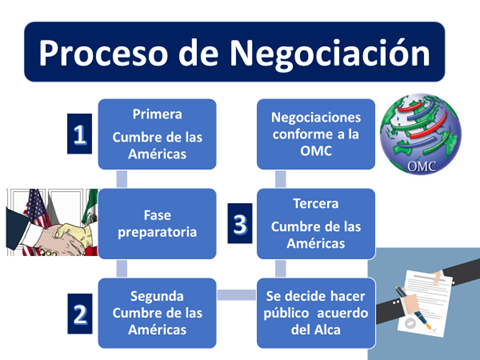
1. First Summit of the Americas
It was the beginning of the negotiations in Miami United States in December of 1,994. Where the declaration of fundamental principles was agreed, the working groups were organized. It was the preparatory phase and four more meetings were held.
- The first in Denver United States in June 1,995
- The second in Cartagena Colombia in March 1996
- The third in Belo Horizonte Brazil in May of 1,997
- The fourth in San José Costa Rica in March 1998
2. Second Summit of the Americas
It was held in Santiago de Chile in April 1998, at this summit they established that the negotiations would be carried out in accordance with the requirements of the WTO (World Trade Organization), for that reason the entire process would be balanced.
The process should be carried out in a transparent way and should encourage the participation of all countries. They would seek to protect the environment, improve people's working conditions and should help improve the standard of living in general.
3. Third Summit of the Americas
It was held in Quebec City, Canada, between April 20 and 22, 2001, where they decided to make public the document that included the first draft of the Alca agreement. It was finally published on the Alca official website on July 3, 2001.
Opposition to Alca
After the Third Summit, a series of protests by anti-globalization groups became generalized in Latin America, which slowed the implementation of the Alca project.
- After that, the only thing that could be achieved was free trade agreements between the United States and some Latin American countries.
- The United States added to the treaties that already existed with Mexico and Chile, trade agreements with countries such as Peru, Panama, Colombia and another with the countries of Central America.
Venezuela the biggest opponent of Alca
The president of Venezuela, Hugo Chávez, was the strongest opponent of Alca, his opposition had a stronger political and ideological charge.
- Unfortunately, with this opposition, a great opportunity was lost for Latin America to expand markets, take advantage of comparative advantages and have great bargaining power, since they could have negotiated jointly as an integrated bloc of countries.
- The project still exists, but it is unlikely that it will be valid again for successful implementation.
Arguments against Alca
The groups that oppose the realization of the Alca project are student groups, unions, environmental groups and all pressure groups, who consider that the majority of Latin American countries will lose in this treaty and that only the big Canadian and American companies they will be favored. Therefore, the winners will be the large investors who will look for cheap labor, as well as resources that they can take advantage of in Latin American countries.
Arguments in favor of Alca
For their part, the people who are in favor of the treaty indicate that by signing the agreement, Latin America would benefit from attracting more investments, there would be more demand for work, better job opportunities and generally better conditions for social and economic development.
- The market would also have a better openness and better possibilities to market goods and services in a more efficient and advantageous way, for that reason companies are favored.
- People in general would improve their quality of life by finding better job opportunities, better income and products of better quality and price.
Leave a Reply