
Volatility pools
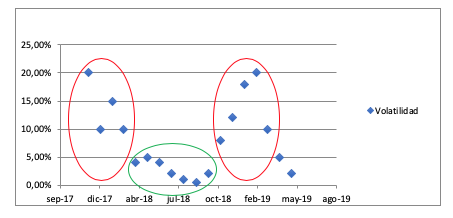
Volatility groupings are sets of standard deviations of a financial asset that are heterogeneously distributed over a time series.
In other words, the volatility of a financial asset is not uniform, that is, it is not constant, over time. So, this volatility will depend on the observations and the period of time which we are evaluating.
When we want to make a statistically satisfactory estimate of the volatility of a period, we should take into account this heterogeneous distribution throughout the time series.
If we assume constant volatility, that is, not conditioned to observations, we can reach wrong results and conclusions when we change the study period. If we change the study period, the observations will also change and therefore the constant volatility initially defined will not reflect the new volatility.
The volatility groupings depend on the frequency of the observations. It is more common to find volatility clusters in daily and monthly data than in annual data.
Application of volatility pools
In more complex cases, how can we find the presence of volatility clusters in the time series?
In the GARCH model we assume that the variance is conditional on the observations. Then the standard deviation (volatility) will also be conditional on the observations. We remember that the squared deviation is the variance.
Using the GARCH model, we find the variance conditioned to a given period of time.
Theoretical example
We assume that the AlpineSki stock is highly exposed to systematic risk during the winter months. So, AlpineSki it will present greater volatility during the winter months than during the other months of the year. We want to estimate the volatility of AlpineSki from October to March 2022. We have information on the price since 1999.
So if we represent the volatility of AlpineSki we will find a volatility group (volatility pool) in the winter months and another volatility group (volatility pool) during the remaining months of the year.
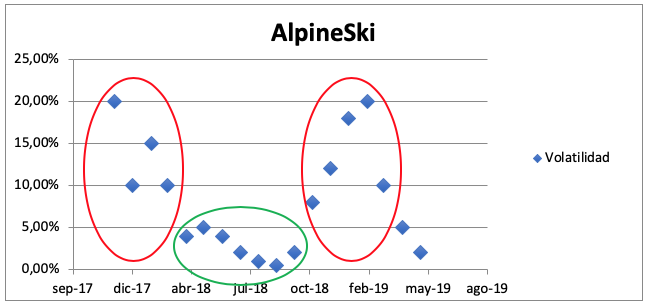
It is important to highlight the study period: it begins in autumn and ends in winter. So, given the information about your exposure to systematic risk, should we consider the possibility that volatility was not the same throughout the study period? In other words, should we use conditional volatility or unconditional volatility?
Unconditional volatility
Volatility that does not change if the observations change.
Process
We calculate the volatility of the study period using a constant predefined volatility. Using this constant predefined volatility implies that this predefined volatility is not variable with observations. That is, if we change the study period, the predefined volatility will not change and we can conclude erroneous results.
Conditional volatility
Volatility that changes if we change the observations.
Process
We do a regression using the GARCH model and calculate the conditional volatility for the study period.
Then, using conditional volatility, that is, it varies depending on the observations, we can make a more precise estimate than if we used unconditional volatility. Thus, if we vary the study period, the conditional volatility will adapt to the new observations.
Question
But… If assuming constant volatility can lead to wrong results, is there a model that assumes constant volatility?
F. Black, M. Scholes and R. Merton will be happy to respond.
Leave a Reply