
Monopoly

What is a monopoly?
A monopoly is defined as the market situation where the manufacture or exploitation of a certain good or service is by a single company, producer or person. That is, with a monopoly there is a single supplier who dominates all market demand.
This word comes from the Greek word monkeys, what does it mean "one", Y polein, what does it mean "to sell". The term refers to the market situation where a single producer is the one that exploits a certain good or service.
Thus, the monopoly is a situation of imperfect competition that very seldom becomes total and absolute. This arises from a market failure or legal privilege.
Monopoly characteristics
Monopoly is not very common in today's market, but it is still present in many countries. Its main characteristics are mentioned below:
- A single company or producer is responsible for manufacturing or selling the product.
- The demand is extremely wide, that is to say that there are many buyers for that product.
- The monopoly company is a pioneer in setting the price since it has no competition.
- It is a type of imperfect market competition.
- There are different barriers for a new competitor to enter the market.
Types of monopoly
There are several types of monopoly with some variation in its structure. Among them we can highlight the following:
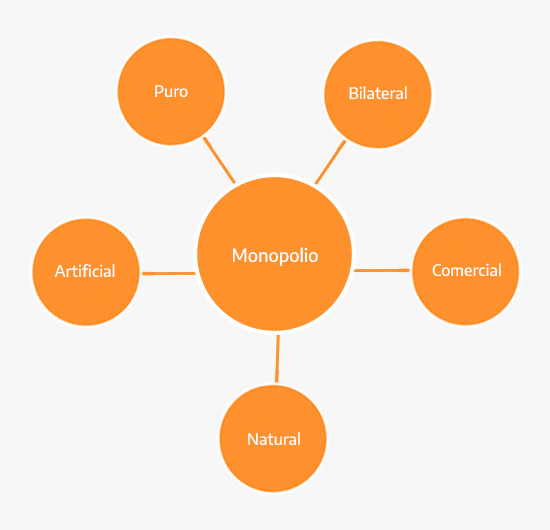
Different types of monopoly.
Pure monopoly
Pure monopoly takes place when a company manufactures a single homogeneous product that it has no substitute and that at the same time has many plaintiffs.
Although today it is difficult to find companies in this situation, it could be said that the company Gillette it has long been in a pure monopoly position, since it has been the manufacturer of a homogeneous product.
Bilateral monopoly
The bilateral monopoly understands that there is only one bidder and only one demanderTherefore, there is a monopoly on the part of the offeror.
For example, a company that manufactures some types of LED screen for the production of a certain smartphone. On this occasion, the price is usually set by whoever is most dependent on the two participants.
Commercial monopoly
This type of monopoly, perhaps one of the most common, is carried out because the producer or supplier is able to cover all market demand at a lower price than the competition, either because it is the only one or because it has a better cost structure, which allows it to offer a better price.
Natural monopoly
The natural monopoly is one that, as its name indicates, usually occurs naturally, that is, when there is a single bidder for many demanders. This is able to offer a product at a better price than its competitors.
For example, a railway company that has the rights to market the routes in a certain country.
Artificial monopoly
This monopoly consists of the monopoly firm prevents other producers from introducing the same product through some specific means, either through violence, artificial barriers or regulatory barriers, some of which can only be enforced by the State.
Difference with oligopoly
Oligopoly can be defined as a market structure where there are a few suppliers, which somehow influence the price and quantity.
There are several differences between monopoly and oligopoly. These are detailed below:
- In the monopoly there is only one supplier, in the oligopoly there are a few.
- In the monopoly there is no agreement between the companies, in the oligopoly there is an agreement on products and prices.
- Monopoly companies set prices themselves, within the oligopoly prices are set by the leading company and the rest are based on it.
- Prices in the monopoly tend to be higher, while in the oligopoly low prices are set.
- The product that is manufactured under a monopoly system is homogeneous or has no substitute, but in oligopoly non-homogeneous products also tend to be used.
Examples of monopoly
Although it is not easy to give an example of this concept, since it is a type of competition generally punishable by law, it usually arises in several countries at a private or public level and indirectly.
Some examples of monopoly are the following:
- Gas service companies: companies that are unique in their country and offer the product through a single medium, which cannot be substituted by another like it.
- Oil companiesOil countries generally establish state-run companies to control the production of oil and its derivatives.
- Electric power companies: As in the previous cases, a single company is in charge of supplying electricity to the country.
Leave a Reply