
Golgi apparatus

The notion of apparatus It can refer to the grouping of elements that, acting in a coordinated way and together, perform the same function. There are multiple devices: among them, the Golgi apparatus.
The Golgi apparatus is called organelle found in cells of the type eukaryote and that is responsible for completing the production process of certain proteins. This apparatus is made up of about eighty dichthyosomes, which are sets of small sacks known as saccules. Dictyosomes, flattened in shape, are located one on top of the other and are protected by a membrane.
The Golgi apparatus, also called Golgi complex, Golgi body Y golgisoma, was discovered by Santiago Ramón y Cajal on 1897. Later, Camillo Golgi was in charge of accurately describing everything related to this organelle, which ended up adopting the Name of the Italian doctor.
The saccules can be grouped in several ways: usually, groups of between four and eight saccules are formed, which make up the dictyosomes. Through different tubes, substances can pass from one saccule to another. The external face of the saccules is directed towards the system baptized as endoplasmic reticulum.
Among the functions developed by the Golgi apparatus are the production of the acrosome that is part of the sperm and the development of primary lysosomes; the elaboration of plasma membrane; cell secretion; and the alteration of the substances synthesized by rough endoplasmic reticulum. In general it can be said that the Golgi apparatus modifies and distributes the macromolecules synthesized by the cell.
Smooth endoplasmic reticulum vesicles
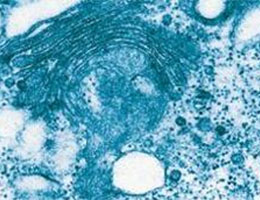
In the smooth endoplasmic reticulum, a few vesicles that when uniting create tube-vesicular aggregates that are carried towards the region cis of the Golgi apparatus by means of motor proteins. The latter, for their part, can advance thanks to the guidance of some microtubules and, when they fuse with the membrane of the device, they empty their content into the lumen.
The molecules that enter the Golgi apparatus are modified, marked, and then sent to their ultimate destination. Proteins carried to distant parts of the apparatus reach the region trans, and they enter a complex network of vesicles and membranes. This is where most of them are marked and sent to their respective destinations through one of the following three types of vesicles, depending on their marker:
* vesicles of exocytosis: are those that contain proteins that will be released when half extracellular. After the internalization of the proteins, the vesicle closes and goes immediately to the plasma membrane, with which it binds to release the content, in a process known as constitutive secretion. An example of this can be seen when antibodies are released by activated B lymphocytes;
* vesicles of secretion: these are those that also have inside the proteins that must be released into the extracellular environment, although it is important to note that, after their formation, these vesicles are stored in the cell and are kept there waiting for the sign that tells them that they should start their activity. At that time, they move towards the plasma membrane, where they discharge their contents, just as exocytosis vesicles do. The name of this process, which takes place when neurons release neurotransmitters, is regulated secretion;
* lysosomal vesicles: these vesicles are responsible for transporting protein lysosomes, small organelles that contain a large number of acid hydrolases. Regarding the type of proteins, they can be membrane or digestive enzymes. To transfer its contents to the lysosome, the vesicle must fuse with a late endosome, as occurs when digestive proteases are delivered to the lysosomes.
Leave a Reply