
Economic blocks
What are the economic blocks?
The economic blocks, also known as trading blocks, are the grouping of several countries with the aim of creating international trade that benefits them.
This union consists of each of the integrated countries offering their own production and services, and at the same time they benefit from what other countries contribute.
Characteristics of the economic blocks
The main characteristics enjoyed by the economic blocks are as follows:
- They incite economic, cultural, social and political globalization.
- The countries integrated in the economic bloc unite to achieve the success in business, in politics and even in law.
- It works towards a common good, offering production and services for the benefit of the communities of the countries included.
Objectives of the economic blocks
The economic blocks pursue different objectives:
- The main objective is the Union of all these countries for the benefit of the companies involved.
- Its performance is not only based on taking advantage of goods and services from other countries, but also to offer economic and commercial cooperation from the strongest points of each country.
- It seeks to eliminate trade barriers by expanding the marketing limit.
How did the economic blocs emerge?
The idea of commercially uniting a group of countries arose after the economic entities of each region saw the possibility of pool resources of each country to benefit financially and culturally. This would include the closest countries and would be aimed at obtaining reciprocal benefits.
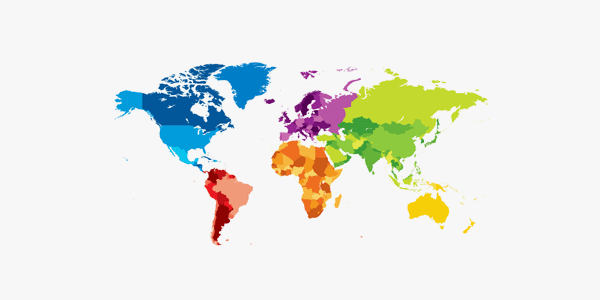
Graph on the main economic blocs in the world.
Importance of economic blocks
We can recognize that blocks are of great importance in the economic development Y material well-being of the countries.
A country that is part of an economic bloc and that is successful in the production of natural goods, will benefit its region and offer its production to other countries, and will also be able to benefit, for example, from the technological services of other countries, creating an economic globalization.
In addition, the economic blocks offer the possibility of carrying out the free trade between communities, which enhances the internal economy and the well-being of their societies.
Examples of economic blocks
The following are some examples of sets of countries that are part of an economic bloc:
- The European Union: made up of Sweden, Finland, Austria, Greece, Luxembourg, Portugal, Spain, Italy, Denmark, Belgium, Holland, Ireland, United Kingdom, France and Germany.
- NAPHTHA: made up of Canada, Mexico and the United States.
- The MERCOSUR: made up of Argentina, Uruguay, Paraguay and Brazil.
- The ANDEAN PACT: formed by Peru, Ecuador, Colombia and Bolivia.
- The APEC: consists of Chile, Vietnam, Peru, Russia, Mexico, Canada, Papua New Guinea, New Zealand, Australia, Philippines, Brunei, Indonesia, Thailand, Malaysia, Singapore, Hong Kong, South Korea, Taiwan, China, Japan and the United United.
- The ASEAN: it is made up of the 10 countries of East Asia.
- The SADC: includes the 15 countries of Southern Africa.
- The MCCA: It is made up of Costa Rica, Honduras, El Salvador, Guatemala and Nicaragua.
- The Pacific alliance: includes Chile, Peru, Colombia and Mexico.
- The BENELUX: it is made up of Luxembourg, the Netherlands and Belgium.
Leave a Reply