
Deflation

What is deflation?
Deflation consists of widespread and widespread fall or decline in the prices of goods and services in an economy. The International Monetary Fund (IMF) establishes that this occurs, at least, in a period of 2 semesters.
Deflation usually occurs when the market demand decreases Y increase the offer. Given this, producers must lower prices to adjust to the new demand.

As market demand falls, prices fall and deflation occurs.
Deflation characteristics
Deflation has the following characteristics:
- It is caused when the supply of goods and services is greater than their demand.
- Due to the drop in prices, the profits of the companies are directly affected.
- Produces unemployment and recession economical.
- It deprives banks of the ability to provide loans.
- Understands 3 types of deflation: historical, corrective and inflationary.
Causes of deflation
Deflation is caused when the supply of goods and services in an economy is greater than its demand. For this reason, the business sector sees the need to reduce prices to be able to sell.
This imbalance between supply and demand usually occurs for two general causes:
- Decrease in demand: when market demand decreases due to various causes, such as the incentive to save, economic uncertainty, etc.
- Supply increase: when the production stock of companies increases for certain reasons and not enough is sold to generate an equilibrium, so these companies face an excess supply. To settle this, prices must be lowered.
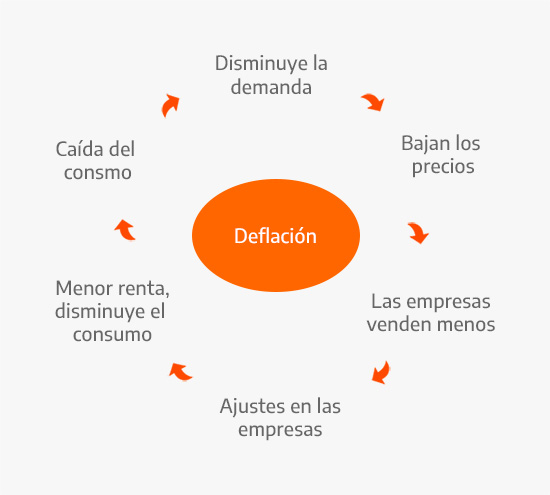
The vicious circle of deflation.
Consequences of deflation
The main consequences generated by deflation are the following:
- Reduced business income: Companies must reduce or decrease the prices of their products to continue in the market, which causes their profits to decrease.
- Reduction of wages and unemployment: Due to falling prices, companies need to minimize expenses and adjust to the new quantity demanded by the market, thus increasing the unemployment rate and reducing wages.
- Changes in customers: Although at the beginning the drop in prices is taken advantage of, in the future consumers or customers are also affected by deflation and begin to reduce their expenses, therefore they stop purchasing goods and services.
- Economic recession: due to the imbalance in the market and the need to reduce expenses to adjust to the new level of sales and prices, a recession occurs in the affected economy.
Types of deflation
Deflation can be historical, corrective or inflationary.
Historical deflation
It occurs slowly and is caused by increased per capita production. It usually occurs in countries like Switzerland, where the value of the currency lasts for a long time and production increases continuously.
Corrective deflation
It is caused after a bubble effect occurs in the economy, when once the money bubble "burst", the economy manages to obtain the prices it had before the inflation caused by said bubble.
Inflationary deflation
Occurs when after having a monetary expansion, prices try to return to the initial moment, that is, those who were there before inflation occurred. However, the Central Bank tends to make this impossible.
Measures against deflation
Here are some measures to combat deflation:
- Apply an expansionary monetary policy, boosting the money supply with the placement of more money in circulation, which encourages consumption and reactivates demand.
- Increase public spending and reduce taxes It will lead to an expansionary fiscal policy that will create jobs and promote consumption and increased demand.
Leave a Reply