
Inflation

What is inflation?
Inflation consists of general and sustained increase in the prices of goods and services in an economy.
The term comes from the Latin word inflatio, which refers to the action of inflating.
Inflation generates a loss in the purchasing power of a population, therefore it causes negative effects on the economy and the inhabitants of a nation.
Causes and consequences of inflation
Causes
The main causes of inflation are the following:
- Demand: When demand increases but the productive sector is not in a position to face the increase, prices rise.
- Costs: When production costs increase, be it due to a devaluation, economic crisis or other reason, producers are forced to increase prices to maintain their profit.
- Social causes or structural inflation: When it is warned about price increases in the future, it is possible that producers decide to anticipate them by raising the prices of their products.
Consequences
The most notable consequence of inflation is that the loss or fall of purchasing power. This causes that, with the same amount of capital or money as before, fewer goods and services are obtained.
In this way, inflation generates economic crisis Y pessimism in the population, as obtaining products becomes increasingly difficult.
Definitely, the higher the inflation, the less the money or capital will be worth.
How is inflation measured?
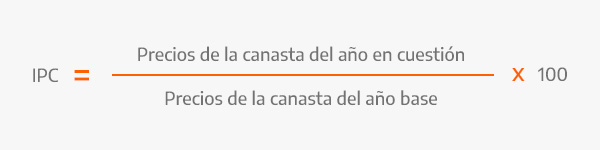
Formula to calculate inflation.
To measure inflation the Consumer Price Index (CPI) is used.
The CPI it reflects the percentage increase in the basket of goods and services in the usual acquisition. In addition, it is used to calculate the real wage index and, in some cases, measure the deflation of the national accounts.
To build a CPI a survey is conducted about family expenses, from a meaningful model of the entire population.
The objective of this survey is to know the circumstances of family life: determine the quantities, services and items that are consumed, in order to calculate the current price of the family basket.
To this basic basket calculated it is divided by the base year to compare and it is multiplied by 100, and from this result the CPI is obtained.
Types of inflation
exist 3 types inflation: moderate, galloping or hyperinflation.
Moderate inflation
Is occurs when the increase in prices happens graduallyTherefore, the proportion that expresses it is low and, therefore, the price relationship remains fairly stable.
As long as it remains in these terms, moderate inflation is not considered a problem for the economy.
Runaway inflation
This happens when prices increase 2 to 3 digits in a year. For example 15%, 20%, 25% per year, and so on progressively.
This type of inflation can have serious consequences for the economy of a country if measures are not taken in time.
Hyperinflation
Hyperinflation is superior to rampant inflation, as it consists of hundreds or thousands of hundreds of annual increase. In this way, hyperinflation is about a serious economic crisis.
According to economists and several international organizations, when inflation exceeds 50% monthly or 100% annually, it is considered hyperinflation.
Leave a Reply